Mobile App Budget in Riyadh 2026 | What Determines the Real Development Cost?
 Abd Elrahman Abdallah
·
·
#AppDevelopment #AppBudget #MobileApps #SoftwareDevelopment #Flutter #AndroidDevelopment #iOSDevelopment #Riyadh #SaudiArabia #DigitalTransformation #TechBusiness #KheljSoftwareSolutions
Abd Elrahman Abdallah
·
·
#AppDevelopment #AppBudget #MobileApps #SoftwareDevelopment #Flutter #AndroidDevelopment #iOSDevelopment #Riyadh #SaudiArabia #DigitalTransformation #TechBusiness #KheljSoftwareSolutions
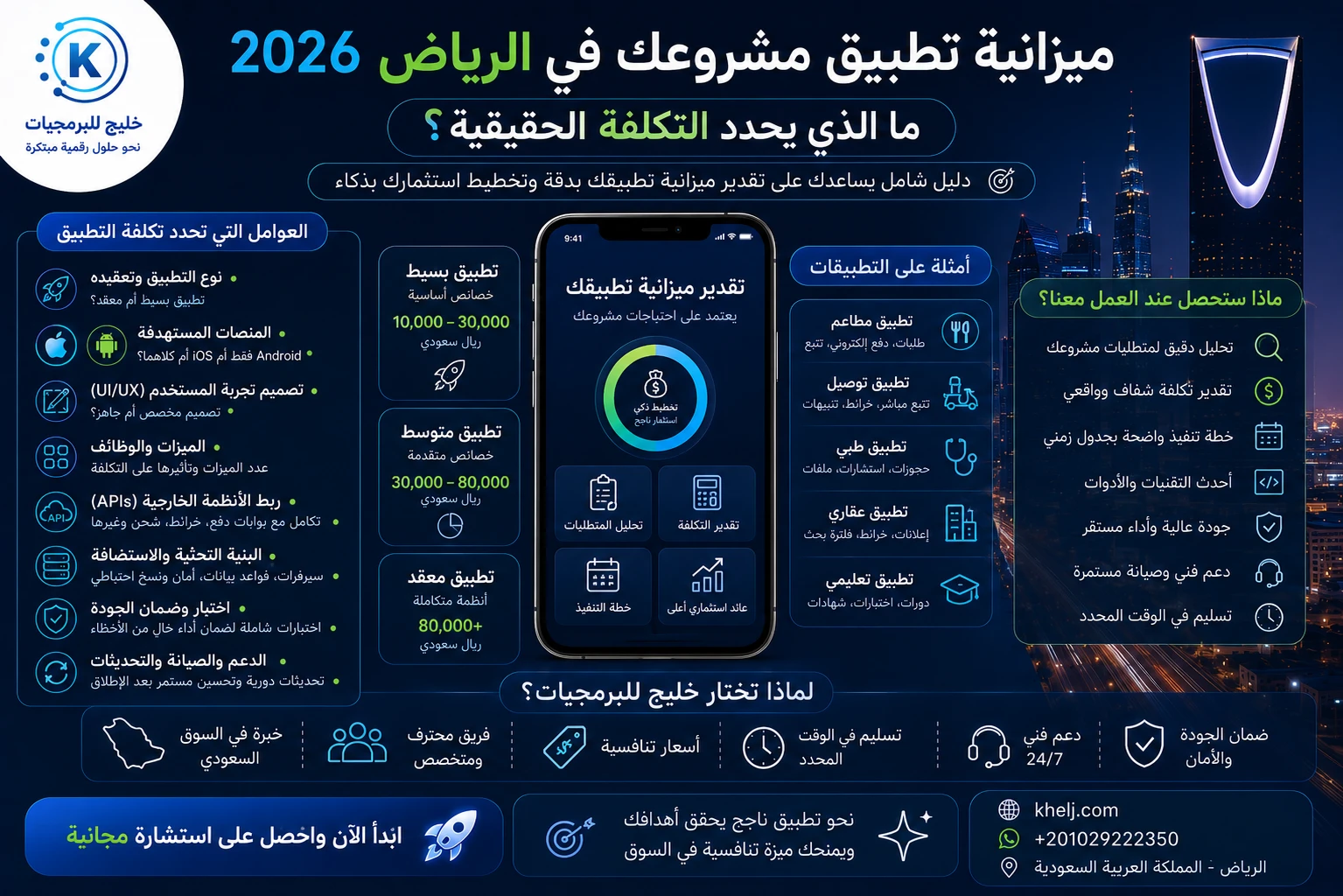
Mobile App Budget in Riyadh 2026 | What Determines the Real Development Cost?
Accurate financial planning is the foundation of every successful project, especially in a dynamic economy like Saudi Arabia. As 2026 approaches, investment opportunities in Riyadh continue to grow, making it increasingly important to understand project budgeting and identify the true cost of mobile app development.
This analytical guide explores the key factors that determine your project's budget and provides practical insights on managing costs effectively to maximize your return on investment.
Small Businesses in Saudi Arabia in 2026
Saudi Arabia continues to experience strong economic growth, while Vision 2030 provides significant support for small and medium-sized enterprises (SMEs).
By 2026, SMEs are expected to play an even greater role in:
-
Diversifying the Saudi economy.
-
Creating new employment opportunities.
-
Encouraging innovation and entrepreneurship.
Launching a successful business in Saudi Arabia requires a deep understanding of the local market, customer expectations, and emerging business opportunities.
Entrepreneurs should focus on innovative ideas that solve real market problems while taking advantage of government initiatives, funding programs, and business incentives available for startups and SMEs.
The Importance of Preparing a Feasibility Study
Preparing a comprehensive feasibility study is the most critical step before launching any business project.
A feasibility study helps evaluate the commercial viability of the project by:
-
Estimating development costs.
-
Identifying required resources.
-
Analyzing the target market.
-
Forecasting revenues and profitability.
-
Assessing potential risks.
A well-prepared feasibility study enables investors to determine whether their business idea is financially viable before committing significant capital.
This process establishes a strong financial foundation that increases the likelihood of long-term success while minimizing investment risks.
Determining Your Project Budget
Defining the appropriate budget is one of the most important aspects of building a successful project in Saudi Arabia.
A complete budget should include every expected expense, including:
-
Initial investment capital.
-
Development costs.
-
Operating expenses.
-
Employee salaries.
-
Office rent.
-
Marketing expenses.
-
Software licensing.
-
Maintenance costs.
A successful budget should also remain flexible enough to accommodate unforeseen expenses while maintaining strict financial discipline.
Accurate budgeting prevents funding shortages during project execution and ensures sufficient resources are available to achieve business objectives.
Successful Small Business Ideas
Saudi Arabia's growing economy continues to create numerous opportunities for entrepreneurs.
Promising sectors include:
-
Technology.
-
Digital services.
-
E-commerce.
-
Food & Beverage.
-
Healthcare.
-
Logistics.
-
Education.
The most successful projects are those that solve genuine market needs while offering innovative value to customers.
Conducting thorough market research before launching a business significantly increases the chances of success.
Managing Your Project Efficiently
Efficient project management is essential in Saudi Arabia's rapidly evolving business environment.
Successful project management combines:
-
Strategic planning.
-
Financial control.
-
Resource management.
-
Team leadership.
-
Performance monitoring.
-
Rapid decision-making.
Every Riyal invested should contribute measurable value to the project.
Maintaining operational efficiency maximizes profitability while improving the project's long-term sustainability.
Budget Management Strategies
Managing your project budget requires both accuracy and flexibility.
Effective budgeting strategies include:
-
Preparing a detailed financial plan.
-
Prioritizing expenditures.
-
Monitoring expenses continuously.
-
Comparing actual spending with planned budgets.
-
Identifying financial deviations early.
-
Taking corrective actions immediately.
Businesses should also seek opportunities to reduce costs without sacrificing quality by:
-
Negotiating with suppliers.
-
Automating repetitive processes.
-
Leveraging modern technologies.
-
Optimizing operational efficiency.
Effective financial management is one of the strongest indicators of long-term project success.
Why Financial Planning Matters in 2026
Financial planning is one of the most valuable investments any business can make.
It enables organizations to:
-
Estimate required funding.
-
Forecast expected profits.
-
Manage cash flow.
-
Prepare for financial risks.
-
Maintain business continuity.
Without a comprehensive financial plan, businesses may encounter unexpected challenges that affect profitability and long-term growth.
Khelj Software's Role in Project Management
Khelj Software plays an important role in supporting digital transformation projects across Saudi Arabia.
With extensive experience in software development and business solutions, the company helps organizations:
-
Accurately estimate software development costs.
-
Plan realistic project budgets.
-
Build scalable mobile applications.
-
Reduce operational expenses through automation.
-
Improve overall business efficiency.
Choosing an experienced technology partner like Khelj Software allows businesses to manage technical aspects more effectively while reducing project risks.
Determining the Real Cost of a Project
Factors That Affect Development Costs
Several factors influence the overall cost of developing a mobile application.
The most important include:
-
Project size and complexity.
-
Number of features.
-
Selected technologies.
-
UI/UX design requirements.
-
Software architecture.
-
Development team experience.
-
Third-party integrations.
-
Security requirements.
-
Maintenance and future updates.
Labor costs also play a significant role, as experienced developers, designers, and project managers command different rates depending on their expertise.
Additionally, compliance with Saudi regulations and industry standards may introduce further development expenses.
Comparing Software Development Companies
When estimating software development costs, comparing different development companies is essential.
Some companies offer:
-
Pre-built solutions at lower prices.
-
Limited customization.
-
Faster delivery.
Others provide:
-
Fully customized software.
-
Premium user experience.
-
Greater scalability.
-
Long-term flexibility.
Businesses should evaluate:
-
Previous projects.
-
Industry experience.
-
Customer reviews.
-
Technical capabilities.
-
Overall value—not just price.
Choosing the right development partner is one of the most valuable investments a business can make.
Common Mistakes When Choosing a Software Company
Many businesses make costly mistakes during the selection process.
Common mistakes include:
-
Choosing the cheapest quotation.
-
Ignoring portfolio quality.
-
Failing to define project requirements.
-
Overlooking maintenance agreements.
-
Not reviewing contracts carefully.
These mistakes often lead to additional costs, project delays, and poor software quality.
Practical Tips for Project Success
Preparing an Effective Feasibility Study
A successful feasibility study should begin with clearly defining project objectives and conducting comprehensive market research.
It should include:
-
Market analysis.
-
Competitive analysis.
-
Financial projections.
-
Revenue forecasts.
-
Operational planning.
-
Risk assessment.
Every investment decision should be supported by realistic financial data.
A well-prepared feasibility study not only helps secure funding but also serves as a roadmap for efficient budget allocation and project execution.
Strategies to Reduce Costs
Businesses can reduce development costs without sacrificing quality by:
-
Negotiating with vendors.
-
Automating business processes.
-
Choosing scalable technologies.
-
Eliminating unnecessary features during the initial launch.
-
Adopting phased development strategies.
Continuous financial monitoring also helps identify opportunities to optimize expenses throughout the project lifecycle.
The Importance of Investing in Small Businesses
Investing in small businesses remains one of the strongest drivers of economic growth in Saudi Arabia.
Small businesses:
-
Create employment opportunities.
-
Encourage innovation.
-
Stimulate local markets.
-
Support Vision 2030 objectives.
Although startup budgets may initially be limited, effective financial planning and disciplined management significantly increase the likelihood of long-term success.
With growing government support and an expanding entrepreneurial ecosystem, 2026 presents an ideal opportunity for launching sustainable and profitable business ventures in Saudi Arabia.